This page has been automatically translated.
For a long time, there was no consultation specifically for children with trisomy 21 in Switzerland. Developmental paediatrician Dr Mark Brotzmann co-founded the first of its kind in German-speaking Switzerland at the beginning of 2019. He told us what it's all about on the occasion of Down Syndrome Awareness Month in October.
Mr Brotzmann, in preparing for this interview, we noticed that: Although people who are not affected know the terms trisomy 21 or Down syndrome, they know very little else about it. Can you briefly update us laypeople?
But with pleasure! Trisomy 21 or Down syndrome are the correct terms. Please don't say «Downy», even if those affected sometimes use it themselves. And «Mongoloid» would really be discriminatory. Incidentally, the term «Down syndrome» was coined by John Langdon Down, a British doctor from the 19th century. And the term «trisomy 21» is used because the anomaly affects chromosome 21 in the body's cells. We are therefore dealing with a genetic disorder in which chromosome 21 is present three times in our body cells and not just twice, as is normally the case. This is usually the result of a faulty chromosome transfer when the maternal and paternal genetic material merge, i.e. when the egg and sperm fuse in the uterus.
How does this anomaly affect a child?
Essentially, it means that the children are conspicuous or limited in their mental, physical and motor development. In addition, there is a certain appearance that is certainly familiar to many: rather short stature, a broad neck, wide-set, almond-shaped eyes and a broad nasal bridge, to name just a few typical characteristics. What is perhaps not as well known as the appearance are the frequent problems with the eyes, the gastrointestinal tract and the thyroid gland as well as serious heart defects. For this reason in particular, sufferers used to have a low life expectancy of only 20 to 30 years. Today, thanks to better surgical techniques, they can live up to 70 years.
«Some children with trisomy 21 are not diagnosed until they are three to five years old.»
Are there actually different degrees of severity in Down syndrome?
In principle, the effects of trisomy 21 can vary greatly from person to person. Around 95 per cent of cases have a so-called free trisomy 21, in which the extra chromosome is found in all body cells. These children develop at very different rates. But this also applies to those not affected. The remaining five per cent or so have a «mosaic trisomy», in which not all cells are affected by the abnormality. These children are less conspicuous, less restricted - both cognitively and linguistically. Some are therefore not diagnosed until they are three to five years old.
UKBB has now had a trisomy 21 consultation hour since the beginning of 2019. How did this come about?
Trisomy 21 is not a rare disease. Prof Peter Weber, Head of Neuropaediatrics, and I had been wondering for some time where all these children were actually being treated. Especially as the many accompanying illnesses and the research situation made it clear how important good overall care is in the long term. Today, precisely because trisomy 21 patients are getting much older, we also know much more about the long-term consequences. For example, that many people with Down syndrome suffer from depression and develop dementia. We realised that until then, at least in German-speaking Switzerland, there were simply no specialised consultation hours that took place regularly and enabled a high-level exchange of information.
How did affected families organise themselves beforehand?
Before the Trisomy 21 consultation hour existed, parents had to use online forums, parents' initiatives or parents' associations, such as Insieme21 seek help. They exchanged ideas with other sufferers there. And those who could afford it travelled to Germany. There have long been specialised centres there. Insieme21 Switzerland, the leading parents' association in German-speaking Switzerland for parents and those affected by trisomy 21, finally complained that it couldn't be that a rich country like Switzerland with high medical standards didn't have its own services. That was actually the starting signal. Today we receive referrals from all over Switzerland and I often approach new parents directly to let them know about the consultation.
«A single paediatrician may see one or two children with trisomy 21 a year, whereas I see a good fifty. That certainly gives you a slightly different perspective.»
What is your Trisomy 21 consultation essentially about?
We want to accompany children and families from the beginning until they are 18 years old and ensure that the necessary measures are taken at the right time. Children should receive regular examinations in line with international recommendations. And, of course, the necessary therapies such as occupational therapy, physiotherapy, remedial education, etc. Our work therefore also involves a great deal of coordination.
What does the consultation offer affected families that a paediatrician in private practice might not be able to offer?
A single paediatrician may see one or two children with trisomy 21 a year, whereas I see a good fifty. You certainly have a slightly different perspective, ask different questions and have a wider network. Families also benefit from this. They receive adequate information and comprehensive counselling. This also includes legal questions or information on how to apply for IV and what organisations such as www.procap.ch, www.proinfirmis.ch and www.insieme.ch can do for you. However, the individual paediatrician still plays a decisive role.
How exactly?
Even though we offer all examinations and treatments at UKBB, we also want to hand over everything that is possible to the paediatricians in private practice in the regions where the affected families live. They know the local services best. And the families already have such a high workload with visits to the doctor, therapies and accompaniment. They should not have to travel long distances for even the smallest clarification. This also applies to other specialists that families rely on. It makes little sense to offer a specialised consultation with a psychologist in Basel for a child from Bellinzona. Good networking is therefore crucial.
«Sexuality is a very important topic for children and young people with trisomy 21. In particular, it's about protecting them from assault.»
How well is the relatively new consultation hour already interlinked with the other disciplines at UKBB?
The cooperation is going extremely well. The first stage has been completed: Children with trisomy 21 who need to see an orthopaedist can be examined by one of us every three months during our regular consultation hours. However, I will remain in charge of the main case. Following this pattern, we want to be able to call in other specialists on an ongoing basis. For example, PD Dr Raoul Furlano with his gastroenterology and nutritional advice team for gastrointestinal issues. The next step, however, will involve working with a doctor from the paediatric and adolescent psychiatry department.
Why psychiatry in particular?
Sexuality is a very important topic for children and young people with trisomy 21. In particular, it is about consent and protecting them from assault. Studies have repeatedly shown that children with cognitive impairments are particularly at risk as they can be easily intimidated. Parents simply need to be aware of this so that they are alert if their child suddenly behaves differently. On the other hand, behavioural problems such as aggression, quick-tempered behaviour, deficits in impulse control, depressive warning signs, etc. can also be addressed there. However, it is certainly also important to support and advise parents in dealing with and living together with a child/adolescent who may have physical or mental developmental delays.
Your consultation hour therefore covers a very wide range of topics.
We also treat children from the age of three months for at least 18 years. That's a long journey together and you encounter a lot of issues. New age, new challenges. And the parents also want to be well supported. After all, highly specialised medicine is one thing, but how to cope with everyday life is another. Many things can be solved with simple means and practical tips. I also talk to the parents a lot about how they themselves can deal with their child's chronic illnesses or cognitive limitations. They are very grateful for this. This is demonstrated by the positive feedback we receive.
«The consultation shows me time and again how to deal with an illness and what parents of affected children do on a daily basis.»
Do you also encounter parents who expect true miracles? For example, that their child will be cured by you?
Most people simply have hopes and wishes. Sometimes you have to bring them back into the framework of reality. But nobody really expects miracles. A lot of educational work is simply needed. Trisomy 21 is life-long. There is no medical cure.
How has your personal view of trisomy 21 changed since you have seen so many cases?
The consultation always shows me very clearly how to deal with an illness and what parents of affected children do on a daily basis. At the same time, I also see the many hurdles that non-affected people put in the way of these families. Especially when it comes to insurance issues and administrative matters. Many things are simply not geared towards people who do not conform to the supposed «normality». If you work in an area like I do, you very soon have a different perspective on what is «normal» and what is not.
What are the results after almost two years of consultation hours?
We have very grateful parents, invariably great encounters during consultation hours and the feedback that those affected are finally being recognised in Switzerland. In my view, the most important goal has already been achieved.
And what else will the future bring?
It would be great if our work also sensitised adult doctors even more. People with trisomy 21 represent an entire patient group that is underserved in adulthood. There is a lack of services that accompany children and adolescents with trisomy 21 into adulthood. I would like to help ensure that closer cooperation is established between paediatric and adult medicine in this area and that a professional transition can be established.
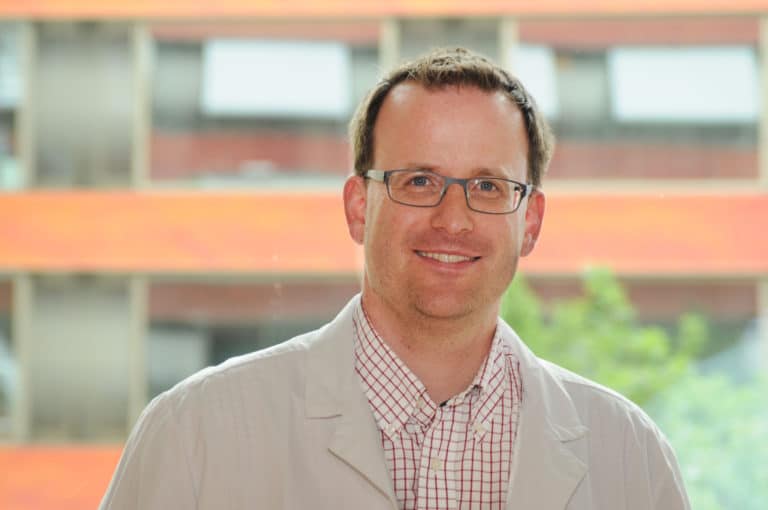
Dr med Mark Brotzmann treats children with motor or speech impairments as a developmental paediatrician. Together with Prof. Peter Weber, Head of Neuropaediatrics at UKBB, he set up the consultation hours for trisomy 21 in 2019. Here, affected families receive holistic care ranging from highly specialised medicine to practical tips for everyday life.
The Medgate Kids Line provides quick and uncomplicated medical advice if your child is unwell. The medical team of our partner Medgate is available to you by telephone around the clock.
For emergencies abroad: Call the emergency number of your health insurance company. You will find this number on your health insurance card.
More information: On the Page of the emergency ward you will find everything you need to know about behaviour in emergencies, typical childhood illnesses and waiting times.
144 Outpatient clinic
145 Tox Info Suisse (Poisonings)
117 Police
118 Fire brigade
Which topic would you like to contact us about?
For praise or criticism, please use the Feedback form.