Contact us
High contrast

Food allergies in children

This page has been automatically translated.

Your child has had an allergic reaction in the past, which is why you have now come to the allergy clinic. Many of your questions have been answered, but given the sheer volume of information, you may not have been able to take it all in. We have therefore put together a brief summary for you here. Should you have any further questions, please do not hesitate to contact the doctor in charge.

What are allergies?

Allergies are excessive, disease-causing reactions by the body to environmental substances that are actually harmless. Sensitisation occurs upon first contact with an allergen, usually a protein.

Almost all children with food allergies also have atopic dermatitis. Why?

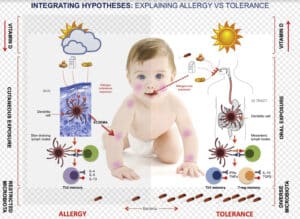
We now believe that children develop sensitisation to various foods via the skin. We therefore regard atopic dermatitis as the starting point of a person’s history of allergies: food allergens come into contact with the immune system through the compromised skin barrier.

In the inflamed skin of a child with atopic dermatitis, a specific immune response develops which can trigger allergies; specifically, so-called IgE antibodies are produced. This is what we refer to as sensitisation. These IgE antibodies attach themselves to specific cells in the skin and lie in wait for the allergen to return, so that they can „protect“ the body against it.

Prevention of food allergies

Sensitisation ≠ Allergy

A sensitisation does not necessarily mean that your child is actually allergic. It simply means that the body has the potential to react allergically. It is also known that the longer a sensitisation persists, the more likely it is that an allergy will develop. It is therefore important, in the event of sensitisation to a foodstuff, to carry out an oral provocation test under medical supervision in order to determine with certainty whether the child is actually allergic or not.


If your child has an allergic reaction, you should avoid giving them that food. If they do not react, you should give them that food at least twice a week. If you do not do this, your child may lose their tolerance and eventually develop an allergy.

My child has never eaten peanuts before, but has still had an allergic reaction – how is that possible?

Allergic reaction

As discussed above, initial contact occurs via the skin, leading to sensitisation. Consequently, an allergic reaction may occur even upon first ingestion.

Why is so much importance attached to skincare?

Skin care

As discussed above, we suspect that the immune system is constantly being stimulated by allergens due to the impaired skin barrier. We know that the more severe the atopic dermatitis, the more likely it is that allergies will also develop. Correct use of steroids (such as Prednitop, Elocom or Locoïd) or calcineurin inhibitors in the form of creams (such as Elidel or Protopic) therefore helps to control the inflammation in the skin, which should not actually be present.

When used correctly following a tapering schedule (starting with daily use, then gradually reducing the dose; do not stop suddenly), this helps to prevent side effects and a flare-up of atopic dermatitis. It is also important not to stop taking the steroids overnight, but to taper them off gradually.

It is also known that constant itching severely affects the child’s quality of life and, consequently, that of the whole family. Many children scratch themselves at night, have trouble sleeping and are often irritable. The skin should be moisturised regularly, sometimes up to 5–10 times a day, to improve the skin barrier.

Can a food allergy be outgrown?

The most common food allergies in the first year of life are to eggs and milk, affecting around 2% of children. It is known that more than 95% of these allergies resolve by the age of five. For other allergies, this rate is not so clearly established; in around 80% of children with a peanut allergy, the allergy persists beyond the age of 4 or 5. After this point, oral tolerance induction can be started to treat this food allergy.

The Atopic March

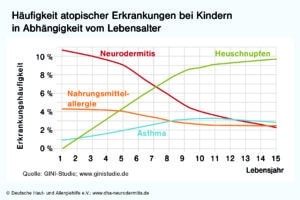
Around 30% of children with atopic dermatitis develop food allergies. Some of these patients may also develop hay fever symptoms from the age of 2, or obstructive bronchitis following infections (dry cough, particularly on exertion, at night or during respiratory tract infections). If your child continues to show signs of obstructive bronchitis after the age of 5, this is referred to as bronchial asthma. Around 50% of children with persistent food allergies go on to develop asthma. This progression from atopic dermatitis, through food allergies and hay fever, to asthma is known as the atopic march.

Introducing solid foods

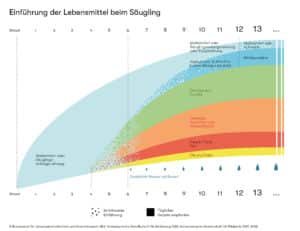
In principle, from the age of 4 months, all foods may be introduced in the same way as for children without food allergies. Any foods that have already been well tolerated should continue to be offered. The only foods that need to be avoided are those to which your child has shown an allergic reaction. Foods that have not yet been introduced and which are known to frequently trigger allergies should first be tested during an allergy consultation before they are offered. It is advisable to introduce as many different foods as possible during the first year of life, as this helps to build up tolerance rather than leading to the development of further allergies. Nuts (ground or as nut butter) may also be offered at this stage.

Counselling hotline for child and youth emergencies

The Medgate Kids Line provides quick and uncomplicated medical advice if your child is unwell. The medical team of our partner Medgate is available to you by telephone around the clock.

058 387 78 82
(billing via health insurance)

For emergencies abroad: Call the emergency number of your health insurance company. You will find this number on your health insurance card.

More information: On the Page of the emergency ward you will find everything you need to know about behaviour in emergencies, typical childhood illnesses and waiting times.

Important emergency numbers

144 Outpatient clinic
145 Tox Info Suisse (Poisonings)
117 Police
118 Fire brigade

UKBB

University Children's Hospital Basel
Spitalstrasse 33
4056 Basel | CH

Contact us

Which topic would you like to contact us about?
For praise or criticism, please use the Feedback form.

Reason for contacting us *

Appointments cannot be booked via the contact form. To book or reschedule an appointment, please contact:

  • Therapies: +41 61 704 12 16
  • Paediatrics and Surgery: +41 61 704 12 20
  • Neuropaediatrics: +41 61 704 26 97
  • Haematology: +41 61 704 12 40
  • Orthopaedics: +41 61 704 28 86
Patient name *
First name patient *
Patient's date of birth *
Name *
First name *
Telephone number
E-mail address *
Your enquiry *
Who should contact you?
How would you like to be contacted? *
Remarks *
Date of cancellation
Contact us by telephone for a new appointment *
Reason for the cancellation